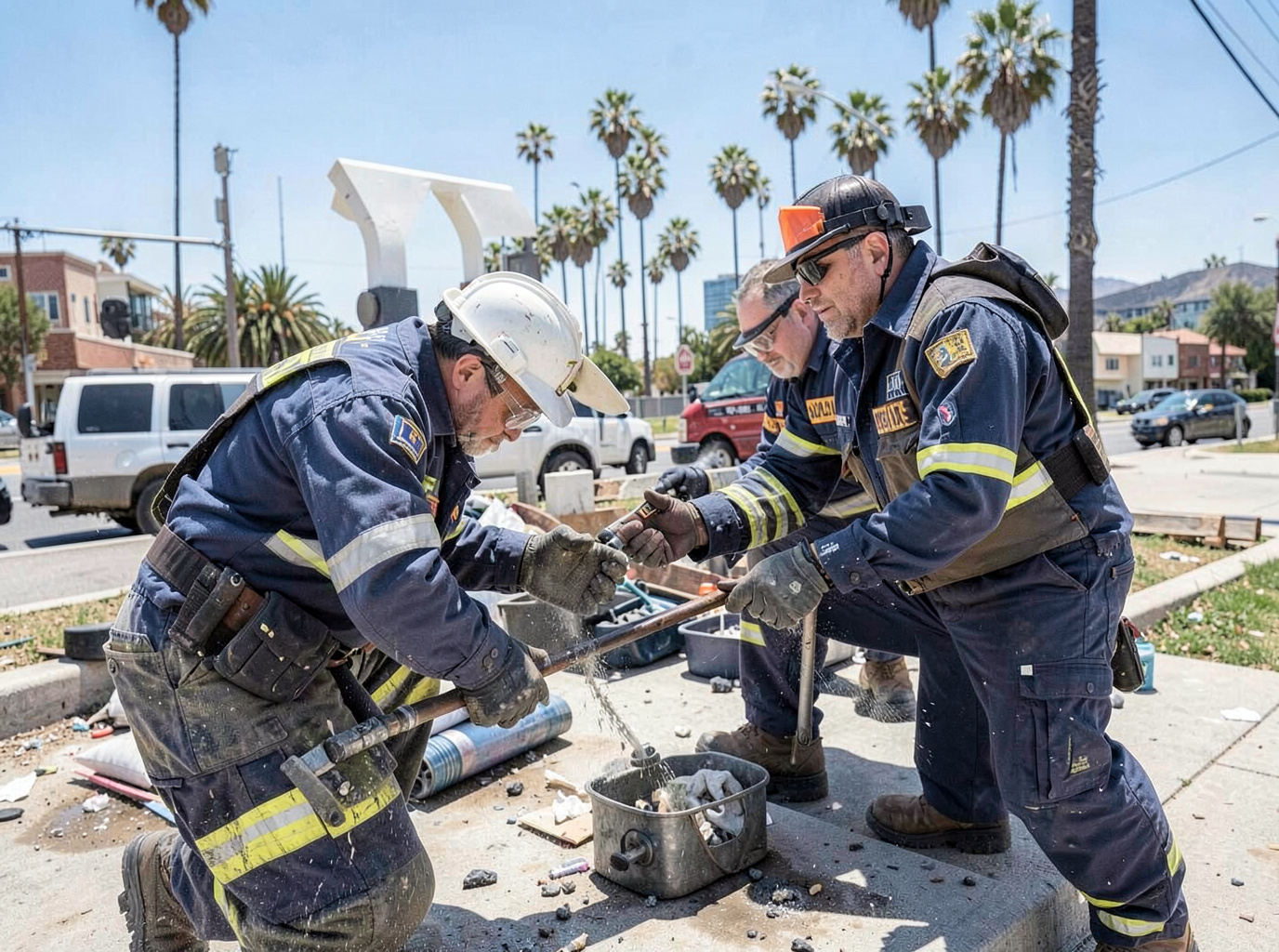
Los Angeles homes built before 1970 often feature plaster walls over wood lath and cast iron or galvanized supply lines that corrode from decades of mineral-rich water. When a line fails in neighborhoods like Boyle Heights or Echo Park, water travels along joists and pools behind baseboards, feeding mold within 48 hours in the mild winter dampness. Technicians must open walls in sections rather than full demolition to preserve original trim and avoid disturbing knob-and-tube wiring still present in many Silver Lake and Koreatown properties.
The region's Mediterranean pattern of warm dry summers followed by sudden winter storms means roof penetrations and hillside drainage issues surface quickly after rain. In areas like East Los Angeles and South Central, older flat-roof apartment buildings and hillside bungalows channel water into stucco cracks that go unnoticed until interior drywall softens. Extraction crews use moisture meters on concrete slabs common in post-1950 construction because trapped water under tile can migrate into adjacent units.
Santa Ana winds accelerate evaporation on exterior surfaces while interior cavities stay saturated, creating hidden mold colonies behind cabinets in Westwood and Hollywood apartments. Restoration work must account for shared walls in dense multi-family buildings where negative air machines prevent cross-contamination into neighboring units. Local code requires permits for structural drying that affects load-bearing elements in older unreinforced masonry structures found in parts of Downtown and Boyle Heights.
Technician insight
In Los Angeles the thing that catches most people out with Emergency Water Damage Restoration is how quickly water travels along the lath in pre-1960 plaster walls common in Echo Park and Boyle Heights. A small leak behind a toilet can saturate an entire exterior wall before anyone notices because the dry summers mask the problem until the next rain.
Ceiling Leak From Upstairs Unit In Koreatown Apartment
Water from a supply line failure on the floor above migrated along joists and soaked the plaster ceiling in a 1920s building. We mapped moisture across three rooms, contained the area to protect neighboring units, extracted standing water, and dried the cavities over five days without removing original crown molding.
Emergency Water Damage Restoration Services We Offer
✓Burst Pipe Water Extraction
Rapid removal of standing water from supply line failures common in pre-1980 homes across Echo Park and Silver Lake using truck-mounted pumps and submersible units.
✓Slab Leak Detection and Drying
Locating and drying water under concrete slabs typical in 1950s-1970s ranch homes in Westwood and Pasadena without full floor removal.
✓Sewage Backup Cleanup
Containment and removal of contaminated water from municipal line backups that affect older gravity systems in East Los Angeles and South Central neighborhoods.
✓Ceiling and Wall Cavity Drying
Targeted drying of plaster and lath assemblies in historic bungalows in Koreatown and Echo Park to prevent hidden mold growth behind original finishes.
✓Multi-Unit Water Migration Control
Isolation of water movement between units in dense apartment buildings common in Hollywood and Downtown using containment barriers and negative pressure.
Emergency Water Damage Restoration Cost in Los Angeles, CA
| Service | Typical Range | What Affects It |
|---|---|---|
| Initial Assessment And Moisture Mapping | $175–$350 | Higher in multi-story or tight-access older homes in hillside neighborhoods |
| Water Extraction Per Day | $450–$900 | Depends on volume and whether sewage contamination is present |
| Equipment Rental Per Day | $250–$600 | Number of air movers and dehumidifiers required for the square footage |
| Wall And Ceiling Cavity Drying | $800–$2,200 | Varies with plaster versus drywall and extent of hidden saturation |
Ranges are typical for Los Angeles, CA and confirmed with an exact written quote before any work starts.
How it works
- 1
On-Site Assessment
Technicians arrive within hours, map moisture with meters, identify the source, and document affected materials in the specific construction type found at the address.
- 2
Water Removal
Standing water is extracted with pumps sized for the volume while protecting adjacent units common in Los Angeles multi-family buildings.
- 3
Drying And Monitoring
Air movers and dehumidifiers are placed, with daily moisture readings recorded until levels match unaffected areas of the structure.
- 4
Restoration Scope
Damaged drywall, insulation, and flooring are removed and replaced, matching original finishes where possible in older Los Angeles homes.
Pricing
Pricing varies by scope, access, and how long water has been present. Upfront written estimates are provided after inspection.